Barcelona to Costa Brava: The Best Beaches, Villages and Hidden Coves for a Day Trip
The Costa Brava starts barely an hour north of Barcelona, but the Costa Brava you’ve seen in photographs — turquoise coves pinched between pine-covered cliffs, whitewashed fishing villages, medieval towns the colour of honey — takes a little more effort to reach. That effort is exactly what this guide is for.
Below you’ll find the best stops for a Costa Brava day trip from Barcelona, organised by the kind of day you want: hidden beaches, medieval villages, wild nature, or postcard fishing ports. For each one we’ve included the distance from Barcelona, the realistic way to get there, and the best time of year to go. First, though, the question everyone asks.
How to get from Barcelona to the Costa Brava
There are four ways to make the trip, and they are not created equal.
By car (1 h – 2 h 15 depending on destination). The AP-7 motorway runs north from Barcelona past Girona; from there, secondary roads wind out to the coast. Driving gives you total freedom, but factor in roughly €10–15 in tolls each way, summer traffic around the beach exits, and the genuine difficulty of parking in tiny villages in July and August. Cadaqués in particular fills its car parks by mid-morning.
By train — sort of. Here’s what surprises most visitors: there is no train from Barcelona to the Costa Brava’s best stretches. The rail line runs inland. The Rodalies R1 gets you to Blanes at the coast’s southern gateway (about 1 h 30, ~€7), and the high-speed AVE reaches Girona in 38 minutes, but Tossa de Mar, Begur, Calella de Palafrugell and Cadaqués all sit 30 minutes to over an hour beyond the nearest station. A barcelona to costa brava train journey always ends with a bus — typically the Moventis-Sarfa coaches from Girona or Barcelona Nord — and rural frequencies can be two or three departures a day outside summer.
By bus. Direct Sarfa coaches run from Barcelona Nord station to towns like Palafrugell (about 2 h, ~€20) and Cadaqués (about 2 h 45, ~€25). Workable for a single destination; hopeless if you want to see more than one place in a day.
By organised excursion. A guided day tour with hotel pickup and private transport is, frankly, how the Costa Brava’s back roads were meant to be handled. You skip the parking wars, string together two or three stops that would be impossible by public transport, and get a local guide who knows which cove is sheltered when the north wind blows. Browse the options on our excursions from Barcelona page — most itineraries below can be covered on one.
Now, the good stuff.
Beaches and hidden coves
The name Costa Brava means “wild coast,” and the calas — small rocky coves — are its signature. Forget the high-rise resorts; these are the beaches worth the drive.
Cala Sa Tuna (Begur) — 130 km from Barcelona
A perfect horseshoe of turquoise water framed by old fishermen’s huts, at the foot of a road that switchbacks down from the hilltop town of Begur. The pebbly beach is small and the setting is absurdly pretty. Come in June or September; in August, arrive before 10:00 or you won’t find anywhere to leave a car. Begur itself — crowned by a ruined castle with views along the whole coast — deserves an hour of wandering before or after your swim.
Platja de Llafranc — 125 km from Barcelona
Llafranc is the Costa Brava at its most elegant: a gentle crescent of golden sand backed by a palm-lined promenade and a small marina, with the lighthouse of Sant Sebastià on the headland above. The walk up to the lighthouse (about 30 minutes) rewards you with one of the best viewpoints on the entire coast. The beach is sandy and family-friendly — rarer than you’d think on this rocky shoreline.
Cala Pedrosa (near Tamariu) — 128 km from Barcelona
This one you earn. Cala Pedrosa has no road access: you reach it on foot along the Camí de Ronda coastal path from Tamariu, a 25–30 minute walk through pines and over rocky headlands. Your reward is a wild pebble cove with astonishingly clear water and a fraction of the crowds. Wear real shoes, bring water, and pack snorkelling gear — the rocky bottom here teems with fish. It’s the definitive answer to anyone searching for hidden coves on the Costa Brava.
Medieval villages
Ten minutes inland from the beaches, the Baix Empordà is scattered with stone villages that look barely touched since the 14th century.
Tossa de Mar — 100 km from Barcelona
The closest of the Costa Brava’s icons and the only fortified medieval town still standing on the Catalan coast. The Vila Vella — a walled old town of cobbled lanes and seven crenellated towers — rises straight out of the main beach, and the view of it at golden hour from the far end of the sand is the Costa Brava’s most photographed scene. Marc Chagall spent the summer of 1934 here and called Tossa his “blue paradise.” It’s reachable by bus from Barcelona or Lloret, but it pairs far better with other stops if you have your own transport. Visit in May, June or late September to enjoy the walls without the crowds.
Pals — 135 km from Barcelona
A hilltop tangle of golden stone: Gothic arches, flower-draped balconies, a Romanesque tower, and a lookout over rice paddies stretching to the sea (Pals still grows its own rice — try the local arròs a la cassola at lunch). Everything is impeccably restored, and on a weekday morning you can have the lanes nearly to yourself.
Peratallada — 130 km from Barcelona
Arguably the finest medieval village in Catalonia, Peratallada means “carved stone,” and the whole village is exactly that — even its defensive moat is hewn straight into the bedrock. It’s tiny, traffic-free and dense with restaurants in vaulted cellars. No public transport reaches it in any useful way, which is precisely why it stays magical. Our medieval Costa Brava tour combines Pals, Peratallada and the coast in a single day with transport handled for you — and if the story of Salvador Dalí tempts you, the medieval Costa Brava and Púbol Castle excursion adds the castle Dalí bought for his wife Gala.
Nature and snorkelling
Illes Medes (L’Estartit) — 150 km from Barcelona
Seven small islands just off L’Estartit form one of the Mediterranean’s most important marine reserves — half a century of protection has produced groupers the size of dogs, forests of gorgonians, and water clarity that feels Caribbean. Glass-bottom boats run from L’Estartit’s harbour for non-swimmers; snorkellers and divers should get in the water. For the full experience, a guided kayak and snorkel Costa Brava excursion takes you along the protected coastline the way it’s best seen: from sea level. Water is warmest from July to September, but visibility is often best in June.
Cap de Creus — 170 km from Barcelona
The Pyrenees’ final plunge into the Mediterranean, and mainland Spain’s easternmost point. This natural park is a lunar landscape of wind-sculpted rock, hidden coves and hiking trails, with a lighthouse at the end of the world. Dalí claimed the rocks here inspired his melting landscapes, and once you’ve seen the tramuntana-twisted stone, you’ll believe him. It’s the wildest, remotest stop on this list — combine it with Cadaqués, below.
Fishing villages
Calella de Palafrugell — 125 km from Barcelona
Whitewashed arcades right on the sand, wooden fishing boats pulled up between sunbathers, and a string of small coves linked by a gorgeous stretch of the Camí de Ronda. This is many Catalans’ favourite village on the coast, and in early July its Cantada d’Havaneres — a festival of sea shanties sung from boats in the bay — is one of the great Costa Brava evenings. From here you can walk the coastal path to Llafranc in 20 scenic minutes.
Cadaqués — 170 km from Barcelona
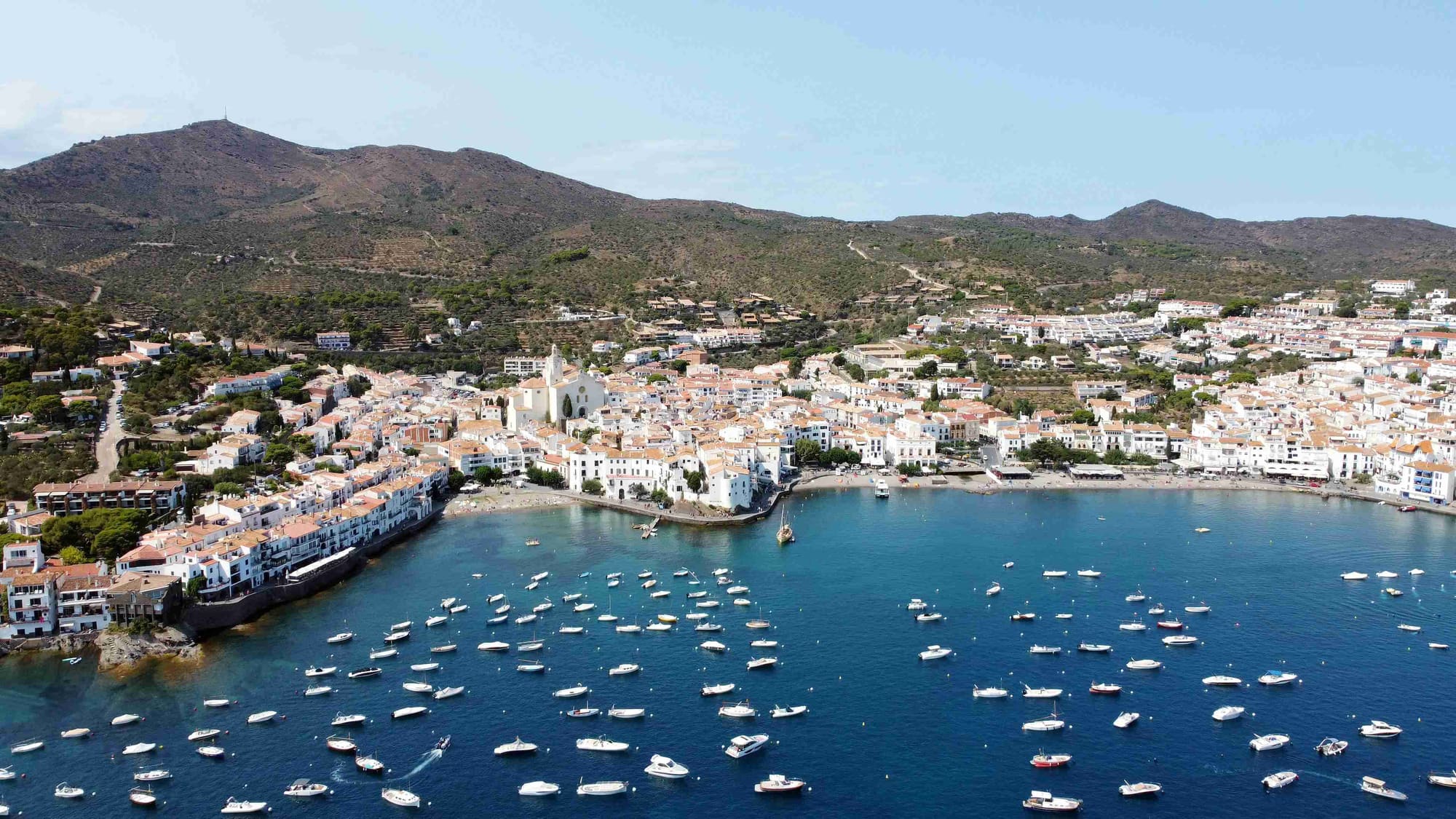
The jewel, and the hardest to reach: the last 30 minutes are a serpentine mountain road over the Pení pass, which is exactly what kept Cadaqués unspoiled while the rest of the Mediterranean built upwards. White houses spill down to a slate-dark bay, and the artistic ghosts are everywhere — Picasso, Miró, Duchamp and above all Salvador Dalí, whose extraordinary house-museum stands in the neighbouring cove of Portlligat. If Cadaqués is your goal, do it properly: the Dalí House, Cadaqués and Cap de Creus excursion covers the village, the house (tickets must be reserved — entry is in small timed groups) and the cape in one day from either Barcelona or Girona. Arriving by sea is even better; in season there’s a boat trip to Cadaqués that shows you the coves no road touches. For more detail on the village itself, see our Cadaqués guide.
Three ready-made one-day itineraries
- Classic first-timer: Tossa de Mar in the morning (walk the Vila Vella before the tour buses), lunch in Pals, golden-hour stroll in Peratallada. Doable only by car or organised tour.
- Beach and boots: Morning swim at Llafranc, Camí de Ronda walk to Calella de Palafrugell for a seafood lunch, afternoon hike to Cala Pedrosa for a quiet second swim.
- The Dalí pilgrimage: Cadaqués village, the Portlligat house-museum, and the Cap de Creus lighthouse — a big day out and far more relaxing when someone else handles that mountain road.
When to go
The sweet spots are late May to early July and September: seawater warm enough to swim, villages alive but not overrun, and easy parking almost everywhere. August delivers the hottest water and the biggest crowds — fine for an organised tour with reserved stops, punishing for independent drivers. Winter has its own melancholy beauty (Cadaqués under the tramuntana wind is unforgettable), though many beach restaurants close from November to Easter.
Frequently asked questions
How do I get to the Costa Brava from Barcelona without a car? Your realistic options are the direct Sarfa coach from Barcelona Nord (good for a single town like Cadaqués or Palafrugell), the train to Blanes or Girona followed by a local bus, or a guided day tour with pickup. For anything involving more than one stop — or any of the hidden coves — the tour is the only option that doesn’t burn half your day on connections.
Is there a direct train from Barcelona to the Costa Brava? No. The train from Barcelona to Costa Brava towns gets you close but never quite there: the R1 line ends at Blanes on the coast’s southern edge, and the inland AVE stops at Girona and Figueres. Every beach and village in this guide requires a bus, taxi or car for the final stretch.
How far is the Costa Brava from Barcelona? The southern gateway (Blanes/Tossa) is about 75–100 km away — roughly 1 h 15 by car. The heart of the coast around Begur, Pals and Calella de Palafrugell is 125–135 km (about 1 h 45), and Cadaqués at the northern end is 170 km, a solid 2 h 15 drive.
Which is the best single stop if I only have one day? For first-timers, Tossa de Mar: it’s the closest, and the walled old town above the beach delivers the full Costa Brava postcard in one stop. For return visitors, Cadaqués and Cap de Creus are the deeper cut — harder to reach, impossible to forget.
Can I swim outside summer? The sea holds 20°C+ from mid-June to mid-October. May swims are brisk but doable; the villages, coves and coastal paths are honestly at their best in the quiet shoulder months either side.
So… car, bus or tour?
If you’re a confident driver visiting one single destination in shoulder season, rent a car and enjoy the freedom. If your heart is set on the inland cities instead, the train is unbeatable — we’ve broken down all the rail options in our guide to day trips from Barcelona by train, and Girona at 38 minutes from Sants is a superb plan B on a windy beach day.
But to see the real Costa Brava — the coves, the stone villages and the fishing ports strung along back roads no train will ever reach — the honest answer is that a guided excursion with local pickup beats everything else on time, stress and the stories you’ll hear along the way. Have a look at our full catalogue of day tours and excursions from Barcelona; we’re Girona locals, this coast is home, and we’d love to show you the version of it that doesn’t fit in a parking app.