Barcelona to Girona Day Trip: The Complete Guide
Thirty-eight minutes. That’s how long the high-speed train takes from Barcelona Sants to Girona — less time than most people spend queueing for the Sagrada Família. On the other end of those 38 minutes: a walled medieval city with the widest Gothic nave on the planet, one of Europe’s best-preserved Jewish quarters, riverside houses in ice-cream colours, a bridge built by Gustave Eiffel, and ice cream made by a family with three Michelin stars.
This is the complete guide to a Barcelona to Girona day trip: every way to get there (with real times and prices), exactly what to see in Girona in one day, where to eat, and an hour-by-hour itinerary that has been walked, timed and refined by local guides.
Is Girona worth a day trip from Barcelona?
Short answer: it’s the best-value day trip in Catalonia, and it isn’t particularly close.
The longer answer is about what kind of day you get. Girona’s entire historic core — the Barri Vell — is compact, car-free and stacked on a hillside between the River Onyar and the old Carolingian walls. Nothing worth seeing is more than a 15-minute walk from anything else. Unlike bigger cities, you don’t spend your day in transit between sights; you spend it inside a single, continuous medieval stage set. Game of Thrones filmed here for a reason (the cathedral steps became the Great Sept of Baelor, and the Jewish quarter stood in for the streets of Braavos).
Add the fastest travel time of any major day-trip destination from Barcelona and the maths becomes very simple: more time in the destination, less time getting there.
How to get from Barcelona to Girona
You have four realistic options. Here’s the honest comparison:
| Option | Time (one way) | Price (approx.) | Best for |
|---|---|---|---|
| High-speed train (AVE/Avlo) | 38 min | from €10–20 | Almost everyone |
| Regional train (R11/MD) | 1h20–1h40 | ~€8–12 | Tight budgets, no rush |
| Bus | ~1h15–1h30 | from ~€13 | Budget backup |
| Car | ~1h15 | fuel only (AP-7 toll-free) | Combining with Costa Brava |
| Organized excursion | door-to-door | varies | Zero-logistics, guided day |
The train from Barcelona to Girona (the winner)
The Barcelona to Girona train is the reason this day trip works so well. High-speed AVE and low-cost Avlo services leave Barcelona Sants roughly every 30–60 minutes through the day and arrive at Girona station in 38 minutes — that’s the real barcelona to girona train time, station to station. Booked a couple of weeks ahead, Avlo fares start around €10 one way; flexible AVE fares run €15–25. Walk-up tickets on busy summer days can hit €30+, so book online (Renfe website or app) once your dates are firm.
Two practical notes:
- Seats are reserved on high-speed services, so you can’t just hop on any train with any ticket. Pick your return time with a little slack.
- If high-speed fares are sold out or pricey, the regional R11/Media Distancia trains run the same route in about 1h20–1h40 for €8–12, no reservation needed. Slower, but a perfectly pleasant plan B.
From Girona station, the old town is a flat 15-minute walk: cross the Plaça d’Espanya, head down Carrer de Santa Eugènia to the Rambla, and you’ll hit the river.
By bus
Direct buses (around 1h15–1h30, from roughly €13) leave from Barcelona Nord and are the fallback if trains are full. Fine, but on this route the train wins on every metric except a couple of euros.
By car
Driving takes about 1h15 via the AP-7 motorway, which has been toll-free since 2021. The catch is Girona itself: the Barri Vell is pedestrianised, and street parking near it is scarce. Use the car parks at the Devesa park or Plaça Catalunya and walk in. A car only really earns its keep if you’re planning to continue to the Costa Brava afterwards.
By organized excursion
The fourth option is a guided day trip with hotel pickup in Barcelona — transport, timing and storytelling all handled for you. If you want Girona and more (many travellers pair it with the Dalí Museum in Figueres in a single day), an organized Girona and Dalí Museum excursion covers ground that’s genuinely awkward to combine by public transport. Browse all current excursions from Barcelona to compare routes and dates.
What to see in Girona in one day
Everything below fits comfortably into a single day on foot. For deeper background on each sight, our full Girona guide goes monument by monument.
Girona Cathedral
Climb the 90 baroque steps (Sept of Baelor, for the Thrones pilgrims) and step into a statistic that doesn’t prepare you for the reality: the widest Gothic nave in the world, at nearly 23 metres. In the 15th century, when the chapter debated whether to continue with three conventional aisles or attempt one impossibly wide vault, the architects voted for audacity — and the single nave they threw across the space still makes first-time visitors stop mid-stride. Don’t miss the Treasury, home to the Tapestry of Creation, an embroidered cosmology from around 1100 that is one of the most important textiles surviving from medieval Europe, and the trapezoidal Romanesque cloister.
The Call Jueu (Jewish Quarter)
Girona’s Call is one of the best-preserved medieval Jewish quarters in Europe — a steep tangle of stone alleys, courtyards and staircases off Carrer de la Força, inhabited by a thriving community from the 9th century until the expulsion of 1492. This was the home of Nachmanides (Bonastruc ça Porta), the great 13th-century kabbalist, and the Museum of Jewish History on Carrer de la Força tells the story with rare depth. Even without entering the museum, walking Carrer de Sant Llorenç at nine in the morning, before the day-trippers arrive, is the single most atmospheric thing you can do in Girona.
The city walls (Passeig de la Muralla)
Girona’s Carolingian and medieval walls are walkable for well over a kilometre, with towers you can climb for views over the cathedral, the rooftops and — on clear days — the Pyrenees. Free, open during daylight hours, and inexplicably skipped by half of all visitors. Enter near the Jardins de la Francesa or behind Sant Domènec and walk south.
The Onyar houses and the Eiffel bridge
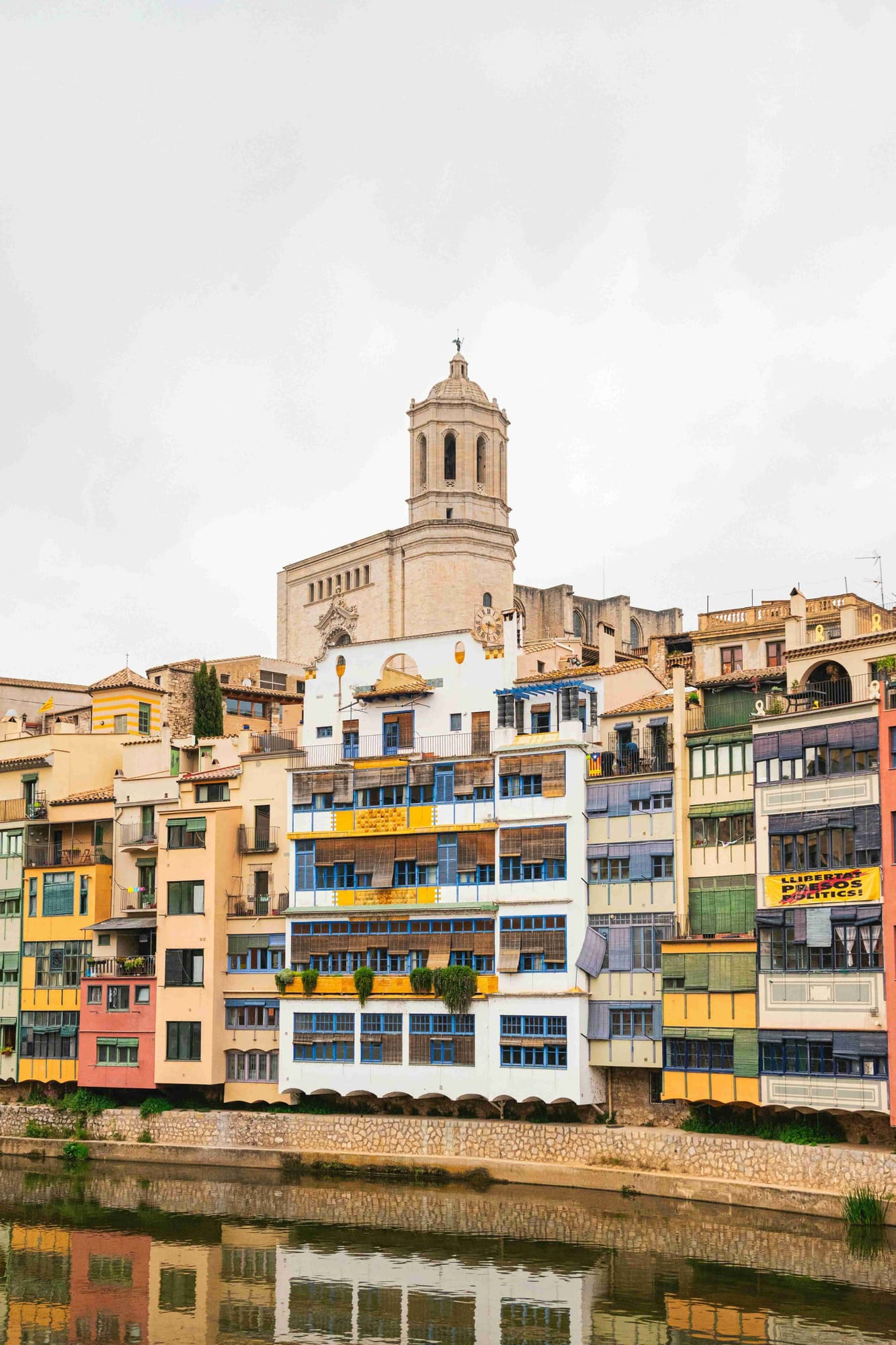
The postcard: a wall of ochre, coral and mustard houses rising sheer from the River Onyar. The best viewpoints are the bridges, and one of them is a celebrity — the red iron lattice of the Pont de les Peixateries Velles, built by Gustave Eiffel’s company in 1877, a decade before a certain tower in Paris. Stand mid-bridge, look north to the cathedral tower, take the photo everyone takes, and don’t feel bad about it.
The Arab Baths and Sant Pere de Galligants
At the northern end of the old town, two Romanesque gems sit a minute apart: the Banys Àrabs, a 12th-century bathhouse (Romanesque, despite the name, but modelled on Muslim baths) with a gorgeous octagonal-columned lantern over the cold pool, and the abbey of Sant Pere de Galligants, one of Catalonia’s finest Romanesque monasteries, now housing the archaeology museum. Both are quick, cheap visits that punch far above their size.
The Basílica de Sant Feliu and the lioness
Just downhill from the cathedral, the Basílica de Sant Feliu was Girona’s first cathedral, and its truncated Gothic spire is the second landmark on every skyline photo. Inside are eight Roman and early-Christian sarcophagi embedded in the presbytery walls — recycled by the medieval builders with magnificent nonchalance — and the chapel of Sant Narcís, Girona’s patron, whose tomb is tied to the city’s strangest legend: when French troops desecrated it during a siege, a plague of enormous flies allegedly swarmed out and routed the army. Girona took the fly as an unofficial mascot; look for it on souvenirs and even on pastries.
Outside the basilica, on Carrer Calderers, stands a stone column with a small climbing lioness — el cul de la lleona. Tradition says whoever kisses the lioness’s backside will return to Girona. The city has thoughtfully installed steps so you can reach. Locals take this seriously enough that the rump is polished smooth; consider it your exit visa.
The Rambla de la Llibertat
Girona’s arcaded main promenade, running along the river — porticoes, café terraces, a flower market on Saturdays. This is where the city itself hangs out, and the natural place to land when your feet need a vermut break. Architecture fans should detour one street over to Carrer de les Ballesteries and look back across the river at the Casa Masó — the only one of the Onyar houses you can actually visit, birthplace of the Noucentista architect Rafael Masó (book the small guided visit ahead if that’s your thing).
Where to eat in Girona
Girona is quietly one of Spain’s great food cities — this is, after all, the home town of the Roca brothers, whose El Celler de Can Roca has twice been named the best restaurant in the world. You won’t get a table there on a day trip (the waiting list runs months), but you can eat their ideas for pocket change:
- Rocambolesc (Carrer de Santa Clara, 50) — Jordi Roca’s ice-cream parlour, right by the Eiffel bridge. Baked-apple soft serve, candy-floss clouds, panets (ice cream stuffed inside a hot brioche). The queue moves fast and it’s worth every minute.
- Mercat del Lleó — the city’s covered market, a 10-minute walk from the Rambla. Come before 14:00 for market-bar tapas among the produce stalls; this is where Girona’s chefs actually shop.
- The Barri Vell terraces — for a sit-down lunch, the streets around Plaça de la Independència (technically across the river) and the Rambla are lined with menús del dia in the €15–25 range. Look for arròs a la cassola and botifarra amb mongetes if you want to eat like the Empordà.
- If you’d rather graze with a local, there’s a guided Girona tapas and historic centre tour that strings the food and the history into one walk.
The perfect 8-hour itinerary
Timed for the fast train out and back. Adjust ±30 minutes to your tickets.
| Time | What you’re doing |
|---|---|
| 08:50 | AVE from Barcelona Sants |
| 09:30 | Arrive Girona; walk to the old town (15 min) |
| 09:45 | Coffee on the Rambla de la Llibertat |
| 10:15 | City walls walk, south to north — morning light, few people |
| 11:15 | Cathedral (nave, Tapestry of Creation, cloister) |
| 12:30 | Call Jueu: Carrer de la Força, Sant Llorenç, Jewish History Museum |
| 14:00 | Lunch — Mercat del Lleó tapas or a Barri Vell menú |
| 15:30 | Arab Baths + Sant Pere de Galligants |
| 16:30 | River time: Onyar houses, Eiffel bridge, photos |
| 17:15 | Rocambolesc ice cream (you’ve earned the panet) |
| 18:15 | Walk back to the station |
| 18:45 | AVE home — Barcelona by 19:25 |
That’s every headline sight, two proper food stops, and zero running.
Five mistakes to avoid
- Booking the return train too early. Girona’s golden hour on the Onyar is the best photograph of the day; an 18:45 departure keeps it, a 17:00 one loses it.
- Starting at the cathedral. Everyone does, which is why it’s calmest before 11:00 only if you go straight there — or better, walk the walls first and arrive at the cathedral from above, through the Jardins de la Francesa. Same sights, reversed flow, half the company.
- Eating on the main square at 14:30 without a reservation. Girona lunches at Spanish hours and the good Barri Vell tables fill fast on weekends. Book ahead, or go the market-bar route at the Lleó.
- Assuming Monday is like any other day. Several monuments and the market keep reduced Monday hours. If Monday is your only option, the walls, the Call streets and the river never close — but check the cathedral and museums first.
- Treating Girona as a two-hour stop. The classic tour-bus mistake: 90 minutes, cathedral steps, back on the coach. Give it the full day; the city’s texture lives in the second and third hours, after the checklist is done.
Go independent or go guided?
The independent version above works. But here’s what a decade of walking these streets teaches you: Girona’s greatness is in its stories, and the stones don’t tell them out loud. The kabbalists of the Call, the 25 sieges the walls survived, why the cathedral gambled on one impossible vault, which legend requires you to kiss a stone lion’s backside to return to the city (real, and locals check) — a good local guide turns a pretty walk into the reason you’ll talk about Girona at dinner parties for years.
If that sounds like your kind of day:
- The Monumental Girona tour covers the cathedral, the walls and the great set pieces in two hours.
- The Jewish Girona and city walls tour goes deep on the Call — the single richest story in the city.
- The full menu of routes, times and prices is on our Girona walking tours page — all led by local guides, all timed to fit around the train schedule.
And if you want the whole day handled — Barcelona hotel pickup, transport, guide, and the option to bolt on Figueres and the Dalí Museum — take a look at the excursions from Barcelona hub. (Speaking of Dalí: if the surrealist thread pulls at you, we’ve written a full guide to doing the Dalí Triangle in a day from Barcelona.)
Practical FAQ
What’s the actual Barcelona to Girona train time? 38 minutes on AVE/Avlo high-speed services, 1h20–1h40 on regional trains. Both run from Barcelona Sants.
How much does the train cost? From about €10 one way on Avlo booked ahead; €15–25 on standard AVE; €8–12 on regionals. Budget €25–40 return per person, less with promo fares.
Is Girona worth a day trip if I only have three days in Barcelona? Yes — it’s the trip we’d sacrifice a Barcelona afternoon for. You lose 76 minutes to travel, total. No other day trip from the city buys this much medieval atmosphere for this little transit time.
Is one day enough for Girona? For the old town, genuinely yes. If you fall for it (common), come back and use the city as a base for the Costa Brava and Figueres.
When should I go? May, June, September, October are perfect. In the second week of May, Temps de Flors turns the entire old town into a flower installation — spectacular, but book trains early. Mondays, some monuments close; check ahead.
Should I buy monument tickets in advance? The cathedral and museums rarely sell out, but online tickets skip the short queues. In July–August, buy the cathedral entry ahead.
The bottom line
A Girona day trip from Barcelona is 38 minutes of travel for a thousand years of city. Take the early fast train, walk the walls before the crowds, give the Call the slow hour it deserves, eat where the market traders eat, and finish with a Rocambolesc cone on an Eiffel bridge. Do it self-guided with this itinerary — or let a local guide carry the stories and the logistics while you just carry the camera. Either way: book the train, and thank yourself at 09:30 tomorrow on the Rambla de la Llibertat.